What Is Circadian Rhythm, and Why Does It Affect Aging?
Somewhere in your brain, right now, a cluster of about 20,000 neurons is keeping time. It's called the suprachiasmatic nucleus, and it doesn't just tell you when to feel sleepy — it conducts a daily symphony across nearly every organ in your body: when your cells repair themselves, when your metabolism speeds up or slows down, when your immune system goes on patrol, and when your hormones rise and fall.
We tend to think of longevity in terms of what we eat, how much we move, and whether we sleep. But research increasingly suggests there's a fourth pillar hiding in plain sight: when we do all of it. Circadian rhythm — your internal 24-hour clock — may be one of the most underrated variables in how well (and how long) you age.
The good news: unlike your genes, your rhythm is something you can actually work with. Let's get into how it works, why it drifts with age, and what the research says about protecting it.
Your Body Has a Clock in Every Cell — Not Just Your Brain

Image from Tally Health
Here's what surprises most people: your master clock in the brain is really more like a conductor. Nearly every tissue — your liver, muscles, skin, even individual cells — has its own local clock running in parallel, each tuned to the master signal but handling its own daily to-do list.
Your liver clock governs when it's most efficient to process glucose and fat
Your muscle clock influences when you build vs. break down tissue
Your skin clock ramps up cellular repair overnight
Your immune clock determines when inflammatory response is dialed up or down
When these clocks stay synchronized with each other — and with the light-dark cycle outside — the body runs efficiently. When they fall out of sync (through irregular sleep, late-night light exposure, shift work, or jet lag), research suggests it may show up as disrupted metabolism, poorer sleep quality, and increased markers of cellular stress over time.
Think of it less like a single alarm clock and more like an orchestra: harmony matters as much as timing.
How Circadian Rhythm Changes as You Age

Image from Tally Health
Circadian rhythm doesn't just help you feel alert or drowsy at the right times — some researchers consider it a "pacemaker" for the aging process itself. As we get older, the amplitude of our circadian signal tends to flatten: melatonin release weakens, core body temperature swings become less pronounced, and the sharp boundary between "awake" and "asleep" states starts to blur.
This is part of why so many people notice their sleep changing in their 40s and beyond — not just less of it, but shallower, more fragmented rest. And because deep, non-REM sleep is when much of the body's overnight repair work happens (clearing cellular waste, consolidating memory, regulating stress hormones), a weakened rhythm may mean your body has a shorter, less efficient repair window each night.
The encouraging part: circadian rhythm is remarkably responsive to input. Light exposure, meal timing, and consistency of routine can all help sharpen a rhythm that's started to fade — at any age.
Circadian Rhythm, Metabolism, and Cellular Repair
Circadian science has moved well beyond "get good sleep." Researchers studying chrononutrition — the timing of meals — have found that eating in alignment with your body's active hours (rather than late at night) is associated with better blood sugar regulation and metabolic markers, independent of what's actually being eaten.
At the cellular level, your circadian clock also regulates autophagy — the cellular recycling process by which cells clean out damaged components — which tends to peak during fasting and sleep windows. A disrupted rhythm may blunt this nightly cellular "housekeeping" shift, one of several reasons circadian health keeps coming up in longevity research alongside inflammation and mitochondrial function.
None of this means perfection is the goal. It means consistency — same sleep window, same rough meal timing, some daylight exposure — is doing quiet, compounding work in the background of your health.
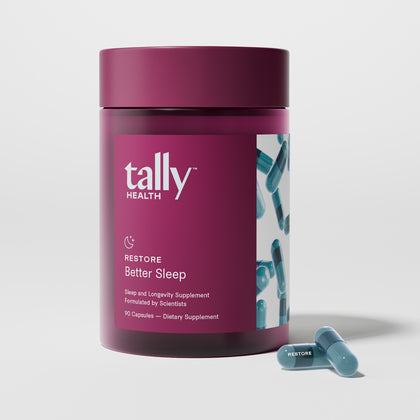
Support Your Sleep and Circadian Health with Tally's Restore

Image from Tally Health
If circadian rhythm is the conductor, sleep is where most of the nightly repair actually plays out — which is exactly where Restore comes in.
Restore is formulated to support the body's natural nighttime recovery processes: helping you fall into deeper, more restorative sleep so the repair and cellular clean-up work your circadian rhythm is designed to do each night has the time and quality it needs to happen. Rather than forcing sleep, it works with your body's existing rhythm — supporting the biological processes that a well-timed, well-synced clock relies on.
Because so much of healthy aging happens while you're asleep, giving your rhythm the support it needs isn't a side note to your longevity routine — it's a foundation for it.
How to Improve Your Circadian Rhythm Naturally

Image from Tally Health
Get outside within an hour of waking: Morning light exposure is one of the strongest signals your master clock uses to set the day's rhythm.
Keep a consistent sleep-wake window: Even on weekends — variability is often more disruptive to circadian health than a slightly later bedtime.
Dim the lights 1–2 hours before bed: Bright, blue-heavy light in the evening can delay melatonin release and blunt your body's wind-down signal.
Eat earlier when you can: Aligning most of your eating with daylight hours may support metabolic and cellular rhythms tied to longevity.
Treat your bedroom like a cave: Cool, dark, and quiet supports the deep sleep stages where much of your nightly repair work happens.
Age on Your Own Time

Image from Tally Health
Circadian rhythm isn't a wellness trend — it's a biological system that's been quietly shaping how well your body repairs, regulates, and renews itself every single day. Supporting it doesn't require a total lifestyle overhaul, just a bit more attention to when, not only what.
Age on your terms with Tally's full supplement lineup. Experience the combined benefits of Vitality, Amplify, Restore, Sharpen, Defend, and NAD+ — six longevity-supporting formulas designed to target aging pathways from every angle, so you can live healthier, longer.
What is circadian rhythm and why does it matter for longevity?
Circadian rhythm is your body's internal 24-hour clock, coordinated by a group of neurons in the brain called the suprachiasmatic nucleus. It regulates when your cells repair themselves, when hormones rise and fall, and when your metabolism and immune system are most active. Research suggests that a well-synchronized circadian rhythm supports healthier aging, while chronic disruption is associated with metabolic and cellular stress over time.
Does circadian rhythm change as you get older?
Yes. As people age, the circadian signal tends to weaken — melatonin release drops, body temperature fluctuations flatten, and the line between wakefulness and sleep becomes less distinct. This is one reason sleep often becomes lighter and more fragmented with age, which may shorten the body's nightly repair window.
How does circadian rhythm affect metabolism and cellular repair?
Nearly every organ has its own local clock synced to your master rhythm, including your liver, muscles, and immune system. Research in chrononutrition suggests that eating in alignment with your body's active daytime hours is associated with better blood sugar regulation, while processes like autophagy — the cellular "clean-up" that clears damaged components — tend to peak during sleep and fasting windows.
References
Verma et al. Circadian clock and its effect on aging and lifespan. Biogerontology 2025.
Duffy et al. Aging and Circadian Rhythms. Sleep Med Clin 2015.
Dhaka et al. The interplay between circadian rhythms and aging: molecular mechanisms and therapeutic strategies. Biogerontology 2025.
Hood and Amir. The aging clock: circadian rhythms and later life. J Clin Invest 2017.
Nagayach et al. Interplay between circadian rhythm, ageing and neurodegenerative disorder. Open Biol 2025.
Tomatsu et al. Clinical Chronobiology: Circadian Rhythms in Health and Disease. Semin Neurol 2025.