Longer days. Brighter mornings. A subtle shift in energy.
As we move into spring, many of us feel a natural reset. You might wake up earlier, feel more alert during the day, or notice your sleep shifting with the sunlight. This isn’t just a seasonal mood. It’s your circadian rhythm at work.
This internal clock influences when you feel awake, when you feel tired, and how your body repairs itself. More importantly, emerging research suggests it may play a direct role in how we age.
So how does circadian rhythm affect lifespan? And what does it have to do with epigenetics, the science of how your genes behave over time?
Let’s take a closer look.
What Is Your Circadian Rhythm and Why Does It Matter?

Image from Tally Health
Your circadian rhythm is a 24-hour cycle that regulates essential biological functions, including sleep, hormone production, metabolism, and body temperature.
This rhythm is primarily guided by light exposure. When your eyes detect light in the morning, your brain signals wakefulness. As darkness falls, your body begins producing melatonin, preparing you for sleep.
This cycle is not just about rest. It helps coordinate when your body performs critical repair processes. When your circadian rhythm is aligned, these systems run efficiently. When it’s disrupted, the effects can ripple across your health.
How Circadian Rhythm Affects Lifespan

Image from Tally Health
Scientists have long studied how circadian disruption and accelerated aging are connected.
Irregular sleep schedules, late-night light exposure, and shift work have all been associated with increased risk of chronic conditions like cardiovascular disease, metabolic dysfunction, and cognitive decline.
But the connection goes deeper than behavior. Your circadian rhythm helps regulate cellular repair, DNA maintenance, and inflammation.
When this rhythm is consistently misaligned, these processes may become less efficient. Over time, that can contribute to faster biological aging.
This is one reason researchers are exploring how circadian rhythm affects lifespan as a key factor in longevity science.
The Link Between Circadian Rhythm and Epigenetics

Image from Tally Health
To understand the deeper impact, we need to look at epigenetics.
Epigenetics refers to how your genes are expressed without changing the underlying DNA sequence. These changes are influenced by lifestyle factors such as diet, stress, and sleep.
Recent research highlights a strong link between circadian rhythm and epigenetics. Your internal clock helps regulate when certain genes turn on and off throughout the day.
When your sleep-wake cycle is consistent, gene expression follows a healthy rhythm. When it’s disrupted, that rhythm can become irregular.
This matters because epigenetic changes are closely tied to aging. In fact, scientists use epigenetic markers to estimate biological age.
So does sleep timing impact epigenetic age? Evidence suggests it does. Irregular sleep patterns and circadian misalignment may accelerate epigenetic aging, while consistent rhythms may help slow it.
How Light Exposure Affects Epigenetics

Image from Tally Health
Light is one of the most powerful regulators of your circadian rhythm.
Morning sunlight helps set your internal clock, signaling when to wake and when to sleep later in the day. Evening light, especially from screens, can delay melatonin production and shift your rhythm later.
Emerging studies suggest that how light exposure affects epigenetics may be more significant than previously thought. Light influences not only sleep timing but also the expression of genes involved in metabolism, inflammation, and cellular repair.
This means your daily light habits could play a role in how your body ages at the cellular level.
Circadian Disruption and Accelerated Aging

Image from Tally Health
When your circadian rhythm is consistently out of sync, your body experiences a form of internal stress.
This can happen due to:
Irregular sleep schedules
Late-night eating
Excessive evening light exposure
Frequent travel across time zones
Over time, this disruption may contribute to:
Increased inflammation
Impaired glucose metabolism
Reduced cellular repair
Changes in gene expression
All of these are associated with aging.
This growing body of research reinforces the idea that circadian disruption and accelerated aging are closely linked.
Fasting, Circadian Rhythm, and Lifespan

Image from Tally Health
Another emerging area of research explores the relationship between fasting, circadian rhythm, and lifespan.
Time-restricted eating, where food intake is limited to a consistent daily window, may help align metabolic processes with your circadian rhythm.
Studies suggest this approach can improve metabolic health, support cellular repair, and potentially influence longevity pathways.
While more research is needed, aligning eating patterns with your internal clock may be one way to support healthy aging.
How to Reset Circadian Rhythm for Longevity

Image from Tally Health
The good news is that your circadian rhythm is highly responsive to daily habits.
If you’re wondering how to reset circadian rhythm for longevity, small, consistent changes can make a meaningful difference.
Here are some science-backed circadian rhythm tips for healthy aging:
Get morning light exposure
Aim for natural sunlight within the first hour of waking. This helps anchor your internal clock for the day.
Keep a consistent sleep schedule
Going to bed and waking up at the same time each day supports stable rhythms and gene expression patterns.
Limit evening light
Reduce screen time 2 to 3 hours before bed or use low-light settings to support natural melatonin production.
Align your meals with your day
Try to eat during daylight hours and avoid late-night meals to support metabolic rhythms.
Prioritize sleep quality and duration
Aim for at least 7 hours of sleep per night to support cellular repair and healthy aging.
The Takeaway: Your Daily Rhythm Shapes Your Future Health

Image from Tally Health
Your circadian rhythm is more than a sleep schedule. It is a foundational system that influences how your body functions, repairs, and ages.
The link between circadian rhythm and epigenetics highlights just how deeply your daily habits can impact long-term health.
As the seasons shift and daylight increases, it’s a natural opportunity to realign your routine.
Prioritizing consistent sleep, morning light, and balanced daily habits can support not just how you feel today, but how you age over time.
Small changes, repeated daily, can help set the rhythm for a longer, healthier life.
Sleep smarter. Age better.
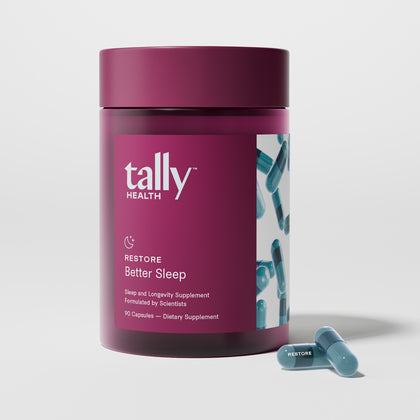
Your circadian rhythm depends on consistent, high-quality sleep. Restore is designed to support your body’s natural melatonin production, promote relaxation through GABA signaling, and help you wind down at night.
With ingredients like an active compound from chamomile, Restore helps you fall asleep more easily and supports healthy aging while you rest.
How does circadian rhythm affect lifespan?
Circadian rhythm regulates key processes like sleep, metabolism, and cellular repair. When disrupted, these systems may become less efficient, which has been linked to increased risk of chronic disease and faster biological aging.
Does sleep timing impact epigenetic age?
Yes. Research suggests that irregular sleep patterns and circadian misalignment can influence gene expression and may accelerate epigenetic aging, while consistent sleep timing may support healthier aging.
How can I reset my circadian rhythm for longevity?
You can support your circadian rhythm by getting morning sunlight, maintaining a consistent sleep schedule, limiting evening light exposure, aligning meals with daytime hours, and prioritizing 7 or more hours of sleep.
References
Verma et al. Circadian clock and its effect on aging and lifespan. Biogerontology 2025; https://doi.org/10.1007/s10522-025-10281-4
Jagota et al. Circadian rhythms in aging and longevity: from molecular chronomics to translational gerontology. Biogerontology 2026; https://doi.org/10.1007/s10522-026-10403-6
Hassan et al. The intricate link between circadian rhythms and aging: can resetting our circadian clock hold the key to longevity? Biogerontology 2025; https://doi.org/10.1007/s10522-025-10299-8
Zhao et al. Restoring circadian rhythms in the hypothalamic paraventricular nucleus reverses aging biomarkers and extends lifespan in male mice. Cell 2026; https://doi.org/10.1016/j.cell.2026.01.016
Acosta-Rodríguez et al. Importance of circadian timing for aging and longevity. Nat Commun 2021; https://doi.org/10.1038/s41467-021-22922-6