If you've spent any time on health TikTok lately, you've probably seen it: creators logging 50, 60, even 80 grams of fiber a day, blending beans into smoothies, eating lentils at every meal, and hashtagging it all #fibermaxxing. It looks like a wellness fad. But the science behind it is anything but new.
Fiber has been quietly sitting at the center of longevity research for decades. In fact, the case for eating more fiber — a lot more fiber — is one of the most robust in nutrition science.
The average American eats about 16 grams of fiber per day while the recommended intake is 25–38 grams. Researchers studying populations with the longest, healthiest lives are regularly consuming 50 grams or more. So before you write fibermaxxing off as just another trend, let's look at what your gut — and your cells — actually have to say about it.
The Gut Feeling Was Real All Along

Image from Tally Health
Your gut contains roughly 38 trillion microbial cells. — These microbes don't just help you digest food. They produce compounds that influence inflammation, immune function, brain chemistry, and how your cells age. And their favorite food? Fiber.
When fiber-fermenting bacteria in your colon break down plant fibers, they produce short-chain fatty acids (SCFAs) — particularly butyrate, propionate, and acetate. Butyrate, the most studied of the three, acts as the primary fuel source for the cells lining your gut wall. It helps maintain the intestinal barrier that keeps inflammatory compounds from leaking into your bloodstream — a phenomenon often called "leaky gut," and one strongly associated with accelerated biological aging. Indeed, dysbiosis is a bona fide hallmark of aging.
Research suggests that higher SCFA production is associated with lower systemic inflammation, better insulin sensitivity, and reduced risk of metabolic disease. In other words, when you eat more fiber, you're not just feeding yourself — you're feeding a microbial ecosystem that actively supports your healthspan.
Butyrate supports gut lining integrity and may reduce inflammatory signaling
Propionate is involved in glucose regulation and appetite signaling
Acetate supports immune function and may influence fat metabolism
The diversity and abundance of fiber-fermenting bacteria is one of the strongest differentiators between the gut microbiomes of people who age healthfully and those who don't.
Fiber, Longevity, and the Blue Zone Connection

Image from Tally Health
If you look at the dietary patterns of people living in the world's so-called Blue Zones — such as Okinawa, Sardinia, the Nicoya Peninsula in Costa Rica, and Ikaria — one thing stands out: they eat a lot of plants. Not all of them are vegetarian, but legumes, whole grains, and vegetables make up the majority of their calories, and fiber intake far exceeds Western averages.
Epidemiological data backs this up at scale. Research has found that people eating the most dietary fiber have a 15–30% lower risk of dying from cardiovascular disease, stroke, type 2 diabetes, and colorectal cancer compared to those eating the least. The researchers concluded that the evidence for fiber's protective effect was "large and consistent."
More recently, research has begun connecting fiber intake directly to indicators of biological aging. One study found that higher dietary fiber intake was associated with lower epigenetic age acceleration, meaning participants who ate more fiber showed less evidence of biological aging relative to their chronological age. Their cells were aging more slowly.
This isn't correlation without mechanism. Fiber reduces inflammatory markers. It improves insulin sensitivity. It supports the production of compounds that regulate cellular repair pathways — including those involved in how your body handles oxidative stress. Fibermaxxing, it turns out, may be one of the most scientifically supported things you can do for your long-term health.
How Much Is Actually "Maxxing"?

Image from Tally Health
Here's where the trend gets nuanced. There's a difference between meaningfully increasing your fiber intake and going from 15 grams to 80 overnight and wondering why you feel terrible.
Fiber increases should be gradual. Your gut microbiome adapts to higher fiber loads over time — typically 2–4 weeks — and too much too fast can cause bloating, gas, and digestive discomfort as your bacteria catch up. The goal isn't to eat as much fiber as possible on day one; it's to progressively expand the diversity and volume of fiber-containing foods until your body becomes accustomed to a higher baseline.
Research also suggests that fiber diversity matters as much as quantity. Different types of fiber feed different bacterial species, so eating a wide variety of plant sources — legumes, whole grains, vegetables, fruits, nuts, seeds — promotes a more diverse and resilient microbiome than eating a lot of one fiber source.
Practical benchmarks to aim for:
Week 1–2: Add one fiber-rich food per meal (e.g., ½ cup beans, a handful of nuts, an extra serving of vegetables)
Week 3–4: Aim for 30+ grams/day with 30+ unique plant foods per week
Long-term target: 40–50 grams/day from diverse sources is where most longevity-focused research sees the strongest associations
What Your Cells Need Alongside Your Fiber

Image from Tally Health
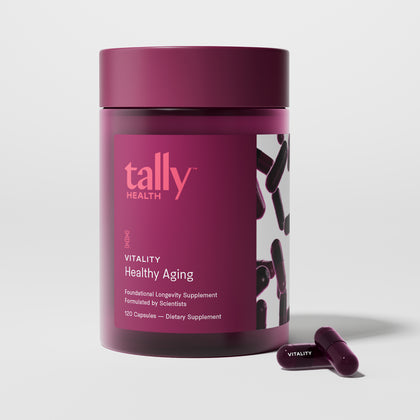
Fiber feeds your microbiome. But your cells also need the right inputs to do what that microbiome enables — running mitochondrial energy production, managing oxidative stress, and supporting the cellular repair pathways that slow down biological aging.
That's where Vitality comes in.
Think of it this way: fibermaxxing optimizes your internal ecosystem. Vitality gives your cells the fuel to act on what that ecosystem produces.
Science-Backed Ways to Fibermax Smartly

Image from Tally Health
Start with legumes. Beans, lentils, and chickpeas are among the highest-fiber foods on the planet and contain both soluble and insoluble fiber. A ½ cup serving of cooked lentils delivers ~8 grams of fiber and feeds some of the most beneficial bacterial species in your gut.
Eat the rainbow — literally. Different pigments in plants correlate with different phytonutrients and different types of fiber. Aiming for 5–6 colors per day is a simple proxy for fiber diversity.
Don't peel your produce. The skin of apples, pears, cucumbers, and potatoes contains significantly more fiber than the flesh. Leaving it on is an easy way to increase intake without changing what you eat. Make sure to wash thoroughly before eating.
Swap refined grains for whole grains. White rice → brown rice adds ~2g fiber per cup. White bread → whole grain adds ~1.5g per slice. These small swaps compound over a day into meaningful increases. As an added bonus, whole grains have more protein than refined grains.
Add flax or chia seeds. Two tablespoons of flaxseed add ~4g of fiber and are an easy mix-in for smoothies, yogurt, or oatmeal. Chia seeds deliver ~10g per 2-tablespoon serving.
Hydrate more as you increase fiber. Fiber absorbs water in your digestive tract. Without adequate hydration, increasing fiber can cause constipation rather than prevent it. Aim for an additional 8 oz of water for every 10g of fiber you add.
Feed Your Microbiome. Fuel Your Cells. Age on Your Terms.

Image from Tally Health
Fibermaxxing is, by most definitions, a trend. But the science underneath it is some of the most consistent and well-replicated in nutrition research. Eating more diverse, high-fiber plant foods doesn't just improve your digestion — it shapes the microbial ecosystem that governs inflammation, immune function, and how fast your cells age.
The good news: you don't need to go from 15 grams to 80 overnight to see the benefits. Small, consistent increases over weeks and months add up to a meaningfully different gut — and meaningfully slower biological aging.
Age on your terms with Tally's Supplement Stack. Experience the combined benefits of synergistic supplements designed to target aging pathways and slow cellular aging so you can live healthier, longer.
What is fibermaxxing and is it actually backed by science?
Fibermaxxing is the practice of dramatically increasing daily fiber intake — often to 50 grams or more. While the trend is new, the science isn't. A landmark Lancet meta-analysis found that people eating the most dietary fiber had a 15–30% lower risk of dying from cardiovascular disease, stroke, type 2 diabetes, and colorectal cancer compared to those eating the least. It's one of the most consistent findings in nutrition research.
How does fiber slow biological aging?
When fiber-fermenting bacteria in your colon break down plant fibers, they produce short-chain fatty acids — particularly butyrate. Butyrate fuels the cells lining your gut wall, helping maintain the intestinal barrier that keeps inflammatory compounds from leaking into your bloodstream. Research suggests that higher fiber intake is associated with lower epigenetic age acceleration, meaning people who eat more fiber show less biological aging relative to their chronological age.
How much fiber should I actually eat, and how do I increase it safely?
Most longevity-focused research sees the strongest associations at 40–50 grams per day from diverse sources — well above the standard recommendation of 25–38 grams. The key is to increase gradually: your gut microbiome adapts over 2–4 weeks, and going too fast can cause bloating and discomfort. Fiber diversity matters as much as quantity, so aim for 30 different plant foods per week — legumes, whole grains, vegetables, fruits, nuts, and seeds.
References
1. Barber et al. The Health Benefits of Dietary Fibre. Nutrients 2020.
2. McKeown et al. Fibre intake for optimal health: how can healthcare professionals support people to reach dietary recommendations? BMJ 2022.
3. Ioniță-Mîndrican et al. Therapeutic Benefits and Dietary Restrictions of Fiber Intake: A State of the Art Review. Nutrients 2022.
4. Ramezani et al. Dietary fiber intake and all-cause and cause-specific mortality: An updated systematic review and meta-analysis of prospective cohort studies. Clin Nutr 2024.
5. López-Otín et al. Hallmarks of aging: An expanding universe. Cell 2023.