You know the feeling.
After a few nights of poor sleep or a stretch of constant stress, everything feels just a bit harder. Your energy dips. Focus takes more effort. Even recovery after a workout can feel slower.
It’s easy to write this off as “just being tired.” But beneath the surface, your cells are working overtime. And one molecule in particular sits at the center of it all: NAD⁺.
Emerging research suggests that the relationship between stress, sleep, and NAD⁺ levels may play a meaningful role in how we age and how we feel day to day.
Why NAD⁺ matters more than you might think

Image from Tally Health
NAD⁺ (nicotinamide adenine dinucleotide) is found in every cell in your body. It helps convert the food you eat into energy, supports DNA repair, and plays a role in how your cells respond to stress.
In many ways, NAD⁺ helps your body do the behind-the-scenes work that keeps everything running smoothly.
But there’s a catch. NAD⁺ levels tend to naturally decline with age. And certain lifestyle factors and stressors can accelerate that decline.
Two of the most important? Stress and sleep.
How stress affects NAD⁺ levels

Image from Tally Health
Stress isn’t inherently bad. In fact, short bursts of stress can be helpful. They sharpen focus and prepare your body to respond. This is the whole idea behind hormesis, which is sometimes described as “what doesn’t kill you makes you stronger”.
The challenge is chronic stress.
When stress becomes ongoing, it becomes overwhelming and your body stays in a heightened state of alert. This increases inflammation and cellular wear and tear. To keep up, your body activates repair systems that rely on NAD⁺.
Over time, this can lead to a mismatch between supply and demand.
Put simply, the more stress your body has to manage, the more NAD⁺ it uses.
This helps explain why the connection between chronic stress and aging continues to be an area of active research.
Sleep: your body’s built-in reset system

Image from Tally Health
If stress increases demand for NAD⁺, sleep is one of the primary ways your body restores it.
During sleep, your body shifts into repair mode. DNA damage is addressed, metabolic processes are recalibrated, and cellular systems get a chance to reset.
These processes rely on NAD⁺.
When sleep is consistent and sufficient, this cycle works as intended. But when sleep is cut short or disrupted, the system becomes less efficient.
What happens with sleep deprivation
Research into sleep deprivation and NAD⁺ points to a few key effects:
Your body experiences more oxidative stress and other types of molecular damage
Circadian rhythms become misaligned
Cellular repair processes are less effective
At the same time, your body may still be using NAD⁺ at a higher rate due to stress and inflammation.
The result is a gradual strain on your cellular systems.
This is one reason why poor sleep is increasingly linked to cellular aging.
The stress–sleep–NAD connection

Image from Tally Health
Stress and sleep don’t just independently affect your health. They interact in ways that can amplify their impact.
Stress can make it harder to fall asleep or stay asleep. Poor sleep, in turn, can increase how reactive you are to stress the next day.
This creates a feedback loop:
More stress
Worse sleep
Higher demand for NAD⁺
Less efficient recovery
Over time, this cycle may contribute to changes in energy, resilience, and overall cellular health.
Understanding this stress sleep NAD+ relationship gives us a clearer picture of how daily habits influence long-term health.
What contributes to NAD⁺ depletion
While aging is the primary driver of declining NAD⁺ levels, several lifestyle factors can accelerate the process:
Chronic stress
Irregular or insufficient sleep
Metabolic imbalance
Inflammation and infection
Among these, stress and sleep stand out because they are both highly impactful and, importantly, modifiable.
Supporting NAD⁺ starts with daily habits

Image from Tally Health, AI-generated performer
The goal isn’t to eliminate stress or achieve perfect sleep every night. That’s not realistic.
Instead, it’s about creating conditions that allow your body to recover more effectively.
A few places to start:
Prioritize sleep consistency
Going to bed and waking up at similar times each day supports your circadian rhythm and helps regulate cellular processes tied to NAD⁺.
Build small stress-management habits
Even brief moments of movement, time outside, or mindfulness can help reduce the overall stress load on your body.
Support your biology
Nutrition, movement, and targeted supplementation can complement these foundational habits.
A practical takeaway
Stress and sleep are part of life. But they also represent two of the most powerful levers you have for supporting your long-term health.
By improving sleep quality and managing stress more intentionally, you’re not just improving how you feel tomorrow.
You’re helping your cells maintain the balance they need to function, repair, and adapt over time.
Sleep deeper. Restore smarter. Age better.

Image from Tally Health
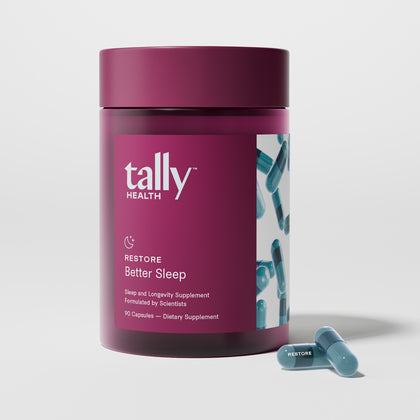
Your nightly routine is one of the most powerful tools you have to support NAD⁺ and healthy aging. Restore is designed to help you fall asleep faster, stay asleep longer, and wake up feeling truly refreshed.
Pair it with NAD⁺ to help fuel the cellular processes that keep you energized and resilient.
How does stress affect NAD⁺ levels?
Chronic stress increases inflammation and DNA damage, which raises the demand for repair processes that use NAD⁺. Over time, this can lead to NAD⁺ depletion.
Does sleep deprivation lower NAD⁺?
Yes. Poor sleep disrupts circadian rhythms and increases cellular stress, both of which can reduce NAD⁺ availability and impair cellular recovery.
What causes NAD⁺ depletion?
NAD⁺ levels tend to decline with age, but lifestyle factors like chronic stress, poor sleep, inflammation, and metabolic dysfunction can accelerate this process.
References
Brenner. Viral infection as an NAD+ battlefield. Nat Metab 2022; https://doi.org/10.1038/s42255-021-00507-3
Lautrup et al. NAD+ in Brain Aging and Neurodegenerative Disorders. Cell Metab 2019; https://doi.org/10.1016/j.cmet.2019.09.001
Kane and Sinclair. Sirtuins and NAD+ in the Development and Treatment of Metabolic and Cardiovascular Diseases. Circ Res 2018; https://doi.org/10.1161/circresaha.118.312498
Lautrup et al. Roles of NAD+ in Health and Aging. Cold Spring Harb Perspect Med 2024; https://doi.org/10.1101/cshperspect.a041193
Levine et al. NAD+ Controls Circadian Reprogramming through PER2 Nuclear Translocation to Counter Aging. Mol Cell 2020; https://doi.org/10.1016/j.molcel.2020.04.010