Totals exclude applicable state/local taxes. Cart contains recurring purchase. You will be charged $0.00 today. Future recurring charges and billing intervals are shown at checkout. Subscriptions continue until cancelled. Contact Tally Support for additional details.
The Longevity Health Plan: How to Build a Life-Long Strategy for Improved Quality of life
Published:
When most people hear the phrase health plan, they think about coverage, enrollment periods, out-of-pocket costs, and whether their primary care provider is in-network. While access to quality care is essential, longevity health requires a broader—and more proactive—approach.
A longevity health plan isn’t just about managing illness or navigating medical services. It’s about building daily routines that support your biology over decades, improve quality of life, and help you stay healthier for longer. This means focusing on prevention, personalization, and long-term value—starting well before emergency care or long-term care services are ever needed.
Below, we’ll explore how to create a longevity health plan that complements traditional health care systems while addressing significant unmet needs in how we support individuals living longer lives.
What Is a Longevity Health Plan?
Image from Tally Health
A longevity health plan is a comprehensive, individualized health strategy designed to extend healthspan—the number of years you live in good physical, cognitive, and emotional health.
Unlike conventional health plans that primarily pay for medical services after symptoms arise, a longevity health plan focuses on:
Preventive, value-based health practices
Personalized routines based on individualized health needs
Daily behaviors that influence long-term biological aging
Ongoing support beyond occasional doctor visits
Think of it as the foundation that supports every stage of life—from early adulthood through seniors navigating age-related challenges.
Why Longevity Requires a New Health Model
Image from Tally Health
Modern medicine has dramatically improved life expectancy. But longer life doesn’t automatically mean better life.
Many individuals face a growing gap between lifespan and quality of life, often dealing with chronic disease, declining mobility, cognitive changes, and rising medical costs. Even the best health plans, Medicare Part options, and independent provider associations are often designed to react—not prevent.
A longevity-focused approach helps fill this gap by addressing:
Lifestyle-driven drivers of aging
Emotional and physical resilience
Long-term metabolic and cognitive health
The rising need for personalized, proactive care
This is especially important as individuals reside longer outside of long-term care facilities and seek to maintain independence.
The Core Pillars of a Longevity Health Plan
Image from Tally Health
1. Nutrition That Supports Long-Term Health
Diet is one of the most powerful tools for longevity health. A strong longevity health plan prioritizes:
Whole, minimally processed foods
Adequate protein to support muscle and metabolic health
Healthy fats to support cardiovascular and brain function
Fiber-rich plants and whole grains to support the gut microbiome
Rather than one-size-fits-all rules, longevity nutrition adapts to individualized health needs, age, activity level, and metabolic health.
Over time, these dietary patterns help reduce reliance on medical interventions and support long-term quality care outcomes.
2. Movement as Preventive Medicine
Exercise is not just about fitness—it’s a form of preventive health care.
A longevity health plan includes:
Strength training to preserve muscle and bone health
Aerobic activity to support heart and metabolic health
Balance, flexibility, and mobility work to reduce fall risk later in life
Regular movement lowers the likelihood of needing emergency care, supports independence, and improves overall rating of life satisfaction as we age. Daily movement is crucial for maintaining muscle mass and bone density, with a recommendation to include resistance training twice a week.
3. Sleep and Stress: The Overlooked Health Services
Sleep and stress regulation are often missing from traditional health plans, yet they are foundational to longevity.
Chronic stress and poor sleep affect nearly every system in the body, including immune function, emotional health, and cognitive performance.
A comprehensive longevity health plan prioritizes:
Consistent sleep routines
Stress-reduction practices like mindfulness or breathwork
Recovery time to support nervous system health
These habits provide long-term value by reducing burnout, supporting mental clarity, and protecting against chronic disease. Prioritizing 7–9 hours of quality sleep is essential for cognitive health and physical repair.
4. Targeted Supplements as Part of a Longevity Strategy
Supplements are not a replacement for diet or medical care—but when used thoughtfully, they can fill important gaps.
This approach aligns with value-based care principles—supporting health proactively rather than reacting to decline.
Personalization Is the Future of Longevity Health
Image from Tally Health
No two individuals age the same way. Genetics, environment, lifestyle, and medical history all influence how we respond to different interventions.
That’s why the most effective longevity health plans are personalized—not unlike how clinical services companies and advanced care centers are shifting toward individualized care models.
Personalization helps ensure:
Better alignment with individual goals
More efficient use of time, money, and resources
Higher long-term adherence and benefits
It’s a collaborative process between individuals, providers, tools, and science-backed products.
How a Longevity Health Plan Complements Traditional Health Care
Image from Tally Health
Traditional health plans, providers, pharmacies, and referral networks play a critical role in treating illness and managing acute needs. A longevity health plan doesn’t replace them—it enhances them.
By focusing on prevention and daily support, individuals may:
Reduce long-term medical costs
Delay or avoid the need for long-term care services
Improve emotional and physical resilience
Maintain independence longer
This integrated approach supports the broader mission of improving health outcomes across the country.
Building Your Longevity Health Plan Starts Today
Image from Tally Health
Longevity isn’t about chasing perfection. It’s about commitment—making small, consistent choices that compound over time.
A strong longevity health plan is built on:
Evidence-based routines
Personalized support
A focus on long-term quality of life
Science-backed tools that evolve with you
At Tally Health, our mission is to make longevity science accessible, actionable, and human—helping individuals build health plans that support not just longer life, but better life.
Because longevity health isn’t something you enroll in once. It’s something you practice every day.
What is a longevity health plan?
A longevity health plan is a comprehensive, individualized health strategy designed to extend healthspan—the number of years you live in good physical, cognitive, and emotional health. Unlike conventional health plans that primarily pay for medical services after symptoms arise, a longevity health plan focuses on preventive, value-based practices, personalized routines, and daily behaviors that influence long-term biological aging.
What are the core pillars of a longevity health plan?
The core pillars of a longevity health plan include nutrition, movement, sleep and stress management, and targeted supplements. This means prioritizing whole, minimally processed foods, strength and aerobic exercise, 7–9 hours of quality sleep, stress-reduction practices, and science-backed supplements that support cellular energy, cognitive function, immune health, and metabolic health.
How does a longevity health plan complement traditional health care?
A longevity health plan enhances traditional health care by focusing on prevention and daily support rather than reacting to illness. While traditional providers and health plans treat acute and medical needs, a longevity-focused approach may help reduce long-term medical costs, delay or avoid long-term care services, improve resilience, and support independence as individuals age.
References
Attia, P. Outlive: The Science and Art of Longevity. Harmony 2023.
Izquierdo et al. Global consensus on optimal exercise recommendations for enhancing healthy longevity in older adults (ICFSR). J Nutr Health Aging 2025; https://doi.org/10.1016/j.jnha.2024.100401
We noticed you have an existing account with Tally. Add products to your existing subscription by going to Manage My Plan within your Account settings.
Want more energy? This supplement is designed to boost metabolism and cellular energy while optimizing mitochondrial function.
What Amplify is made of:
Glycine
1,000mg
Berberine
600mg
Coenzyme Q10
200mg
What Amplify does:
Increases NAD+
Supports healthy metabolism
Boosts muscle recovery
Suggested Use:
Take three capsules daily, with food, to help promote metabolism and energy.
Meet Defend
Defend is designed to promote a healthy, vibrant immune system while simultaneously targeting immune-related aging hallmarks.
What Defend is made of:
Quercetin
500mg
Vitamin C
90mg
Beta-glucan
30mg
Zinc
11mg
Vitamin D3
1000IU
What Defend does:
Reduces inflammaging
Offer protection against acute respiratory infections
Help decrease the duration of respiratory infections
Stimulate the activity of white blood cells, which fight infection and repair normal cell function
Suggested Use:
Take 2 capsules daily with food (including a healthy fat).
Meet NAD+
NAD+ is designed to help elevate NAD+ levels to fuel key cellular functions that support healthy aging.
What NAD+ is made of:
Niacinamide
1000mg
What NAD+ does:
Promotes mitochondrial energy production and metabolism
Helps protect against oxidative stress
Maintains skin health
Supports sirtuin proteins
Suggested Use:
Take 2 capsules daily with food.
Meet Restore
Support healthy aging as you sleep. This supplement will help you fall asleep and stay asleep so you wake up refreshed and recharged.
What Restore is made of:
Magnesium bisglycinate chelate complex
250mg
L-theanine
200mg
Apigenin
50mg
What Restore does:
Enhances sleep quality
Makes it easier to fall asleep
Improves restless leg syndrome
Supports restorative sleep
Promotes relaxation
Helps relieve anxiety
Promotes a positive mood
Suggested Use:
As needed, take three capsules 30-60 minutes before bed.
Meet Sharpen
Sharpen is the key to unlock better memory, clearer thinking, and improved focus as you age. Keep your mind sharper, for longer.
What Sharpen is made of:
Taurine
1000mg
Choline
200mg
Vitamin B6
1.7mg
L-methylfolate
400mcg DFE
Vitamin B12
2.4mcg
What Sharpen does:
Supports long-term cognitive health, brain aging, and overall performance
Lowers a risk factor for dementia by decreasing homocysteine levels
Supports cholinergic signaling, essential for the encoding of memories
Promotes aspects of focus and performance
Suggested Use:
Take 2 capsules daily, with food.
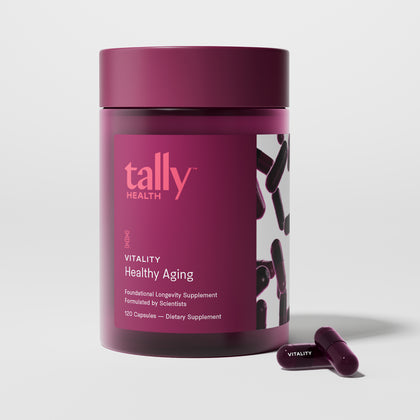
Meet Vitality
Slow aging at a cellular level. This supplement is designed to target all 12 hallmarks of biological aging.
What Vitality is made of:
Calcium Alpha-Ketoglutarate
1,000mg
Quercetin
500mg
Trans-resveratrol
500mg
Fisetin
50mg
Spermidine
900mcg
What Vitality does:
Induces autophagy
Maintains your epigenome
Removes senescent “zombie” cells
Activates sirtuins and repair processes
Suggested Use:
Take four capsules daily, with food (preferably including a healthy fat), to help promote your body's defense against aging.
Membership Benefits
Every six months, we’ll send you a TallyAge™ Test to measure your progress and improve your personalized action plan. Along the way, we’ll send our daily Vitality supplement and help you make powerful changes to unlock deeper health and vitality, for an even better you.
Bi-Annual Testing
Simply swab your cheek and drop the test kit in your mailbox. Our lab team will take care of the rest. Our TallyAge™ metric, developed from the world’s most comprehensive DNA methylation dataset of adult cheek cells, is an indicator of how you're aging on a biological level.
Personalized Recommendations
The results are in. You’ll get accurate insights into your biological health and aging - plus, a personalized action plan that highlights the high impact changes you can make to your lifestyle and daily habits to slow aging. Each recommendation is backed by efficacy data from groundbreaking research. All available, at the touch of a button, through Tally Health’s intuitive digital platform.