Your immune system doesn't clock out. Even when there's no infection to fight, it keeps a low hum of inflammatory activity running in the background — and that hum gets louder with every passing decade. Researchers call this inflammaging: chronic, low-grade inflammation that builds quietly over years and accelerates biological aging long before it shows up as a diagnosis.
What Is Inflammaging?

Image from Tally Health
Inflammaging isn't the inflammation you feel — no fever, no swelling, no pain. It's a persistent, low-level elevation of inflammatory markers like C-reactive protein (CRP), interleukin-6 (IL-6), and TNF-alpha that climbs gradually with age, even in people who feel perfectly healthy. The term was coined in 2000 by immunologist Dr. Claudio Franceschi, who proposed that this slow-burning inflammatory state is a defining feature of the aging immune system itself, not just a symptom of disease.
Think of it like a smoke alarm with a dying battery: it doesn't go off, but it chirps just often enough, just quietly enough, that you stop noticing — while the underlying wiring keeps degrading in the background.
Tally Health's TallyAge Test measures biological age through DNA methylation patterns, which is one reason inflammaging matters beyond immunology — the two processes move together.
How Chronic Inflammation Accelerates Biological Age

Image from Tally Health
The connection between inflammaging and biological age isn't theoretical. Research has found that greater systemic inflammation is positively associated with faster DNA methylation age acceleration across various epigenetic aging clocks — and systemic inflammation itself can even predict future mortality risk.
These findings matter for a specific reason: it suggests inflammaging isn't just a bystander to aging — it's actively involved in setting the pace. When inflammatory signaling stays switched on for years, it keeps stress-response genes active and disrupts the cellular maintenance processes — DNA repair, protein cleanup, energy metabolism — that would otherwise keep tissues functioning like a younger version of themselves.
This is also why inflammaging shows up across such a wide range of age-related conditions. Persistently elevated CRP and IL-6 contribute to endothelial damage and lipid buildup in blood vessels, a driver of atherosclerosis. In the brain, chronic activation of immune cells called microglia and the cytokines they release are linked to worsening damage in Alzheimer's and Parkinson's disease. It's one biological process showing up in very different organs.
Where Inflammaging Comes From

Image from Tally Health
Inflammaging doesn't have a single cause — it accumulates from several overlapping sources.
Senescent cells: As cells age, some stop dividing but don't die off. Instead, they linger and secrete inflammatory signals — a pattern called the senescence-associated secretory phenotype (SASP) — that recruits more inflammatory activity nearby.
Immune system remodeling: With age, the thymus produces fewer new immune cells, while existing ones shift toward a more inflammatory, less adaptable state.
Chronic low-level stressors: Long-term viral exposure (like cytomegalovirus), gut microbiome shifts, environmental toxins, and years of metabolic strain all keep the immune system on partial alert.
None of this means the immune system is broken — it means it's responding to real accumulated signals, the way a muscle that's been under constant low-level tension stays tense even after the load is removed.
Supporting a Balanced Immune Response as You Age

Image from Tally Health
Because inflammaging builds gradually, the most effective response is also gradual: consistent habits that keep inflammatory signaling from compounding, rather than one-time fixes.
Sleep loss also hits your mitochondria directly. Research shows it reduces activity in the mitochondrial electron transport chain and suppresses a cellular cleanup process called mitophagy — the mechanism your cells use to clear out damaged mitochondria. Without it, damaged mitochondria accumulate, oxidative stress rises, and that stress feeds back into more inflammation. It's a loop: bad sleep drives inflammation, inflammation disrupts sleep-regulating rhythms further, and the cycle reinforces itself.
Sleep quality matters more than people expect.
Poor sleep is associated with elevated inflammatory markers the following day, and the relationship compounds over years of disrupted sleep.
Diet composition shifts the baseline.
Diets higher in polyphenols, omega-3s, and fiber are associated with lower circulating inflammatory markers compared to diets higher in refined carbohydrates and processed fats.
Movement helps regulate, not just burn calories.
Regular moderate exercise is associated with lower baseline CRP and IL-6 over time, likely through its effects on visceral fat and metabolic signaling.
Micronutrient status plays a supporting role.
Zinc, vitamin D, and vitamin C are each involved in regulating immune cell activity and white blood cell function — deficiencies in any of them are associated with a less balanced inflammatory response.
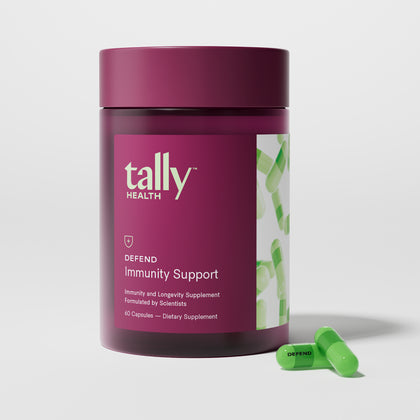
Support Immune Health with Tally Health's Defend

Image from Tally Health
Inflammaging is a long game, which means the most useful interventions are the ones you can sustain — not the ones that promise to reverse it overnight.
Defend was formulated to support a healthy immune system while targeting the immune-related hallmarks of aging behind inflammaging. It combines quercetin, vitamin C, beta-glucan, zinc, and vitamin D3 — nutrients involved in healthy white blood cell activity and a balanced inflammatory response — into a single daily formula designed for consistent, long-term use rather than short-term symptom relief.
See what your biological age says about your inflammatory aging trajectory — pairing the TallyAge Test with daily support like Defend gives you both the measurement and the input side of the equation.
What is inflammaging?
Inflammaging is chronic, low-grade inflammation that builds gradually with age, even without infection or illness. It's marked by persistently elevated inflammatory markers like CRP, IL-6, and TNF-alpha, and research suggests it plays an active role in accelerating biological aging rather than simply resulting from it.
Does chronic inflammation actually speed up biological aging?
Research using epigenetic clocks has found that people with higher systemic inflammation tend to show faster DNA methylation age acceleration — a marker of biological aging — and that inflammation levels can predict mortality risk independent of biological age itself. The relationship appears to run in both directions over time.
How do you know if you have inflammaging?
Inflammaging typically doesn't cause noticeable symptoms on its own, which is part of what makes it hard to catch. It's usually identified through blood biomarkers like CRP and IL-6, or inferred from biological age testing, since inflammation and epigenetic aging tend to move together.
Can you lower inflammaging naturally?
Sleep quality, a diet higher in polyphenols and fiber, regular moderate exercise, and adequate levels of nutrients like zinc and vitamin D are all associated with lower baseline inflammatory markers. These habits work gradually rather than immediately, which matches how inflammaging builds in the first place.
References
- Karpuzoglu et al. Inflammaging: triggers, molecular mechanisms, immunological consequences, sex differences, and cutaneous manifestations. Front Immunol 2025.
Dugan et al. Inflammaging as a target for healthy ageing. Age Ageing 2023.
Zeidan et al. Inflammaging: From Mechanisms to Clinical Implications and Targeted Interventions. Aging Dis 2026.
Franceschi et al. Toward precision interventions and metrics of inflammaging. Nat Aging 2025.
Andonian et al. Inflammation and aging-related disease: A transdisciplinary inflammaging framework. Geroscience 2025.